

By Kelsey Lee MS. RD.

As Americans live longer, maintaining brain health has become an increasingly important part of healthy aging. According to the National Center for Health Statistics, approximately 4% of adults age 65 and older in the United States have been diagnosed with dementia. While there is currently no cure for dementia, researchers continue to discover ways that lifestyle choices may help reduce risk and support cognitive health over time.
One of the most promising areas of research focuses on nutrition. In recent years, scientists have found growing evidence that certain eating patterns may help protect the brain and potentially delay the onset of cognitive decline.
What is Dementia?
Dementia is not a single disease. Rather, it is a general term that describes a group of symptoms affecting memory, thinking, problem-solving, communication, and the ability to perform everyday activities.
Several conditions can cause dementia, including Alzheimer’s disease, Lewy body disease, Parkinson’s disease, vascular dementia, and frontotemporal degeneration. Alzheimer’s disease is the most common cause, accounting for an estimated 60% to 80% of dementia cases. However, many people experience “mixed dementia,” meaning multiple conditions contribute to their cognitive decline.
Understanding Risk Factors
Some risk factors for dementia cannot be changed. These include:
- Aging
- Family history of dementia
- Certain genetic factors, such as the APOE-e4 gene
- Genetic conditions such as Down syndrome
However, researchers have identified several lifestyle factors that may help reduce dementia risk, including:
- Engaging in regular physical activity
- Maintaining healthy blood pressure
- Avoiding smoking
- Improving sleep quality
- Staying socially and mentally active
- Pursuing higher levels of education
- Following evidence-based dietary patterns that support cognitive health
How Diet Affects Brain Health
Research consistently shows that dietary patterns rich in fruits, vegetables, healthy fats, and whole foods are associated with better cognitive outcomes. Three eating plans, in particular, have been linked to improved brain health:
- The Mediterranean Diet
- The DASH Diet (Dietary Approaches to Stop Hypertension)
- The MIND Diet (Mediterranean-DASH Intervention for Neurodegenerative Delay)
In contrast, the typical Western diet, which is often high in saturated fats, refined sugars, and heavily processed foods, has been associated with poorer cognitive health and a higher risk of cognitive decline.
A recent study examining the brains of 581 older adults found that people who closely followed the Mediterranean or MIND diets had lower levels of beta-amyloid, a protein associated with Alzheimer’s disease. The study also found that higher consumption of green leafy vegetables, fish, and seafood was linked to a lower risk of Alzheimer’s disease. Meanwhile, diets high in fried and fast foods were associated with increased levels of tau tangles, another hallmark of Alzheimer’s disease.
What is the MIND Diet?
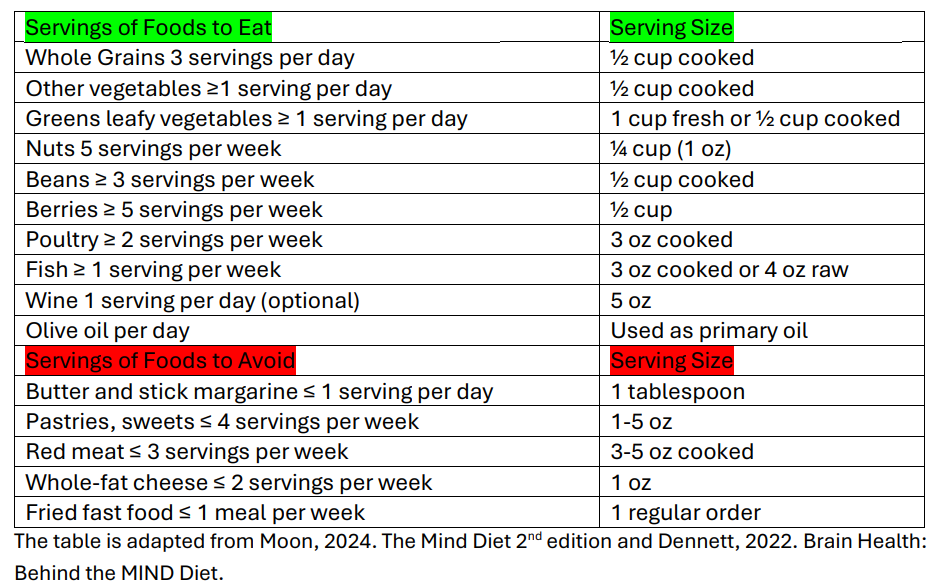
The MIND diet was specifically designed to support brain health by combining elements of the Mediterranean and DASH diets.
It consists of a 15-point scoring system that encourages the consumption of 10 food groups known to support cognitive health, while limiting 5 food groups that may impair it. Achieving a score of 8.5–12.5 (tier one) or 7–8 (tier two) has been associated with a significantly lower risk of Alzheimer’s disease. Each food group guideline followed contributes one point to the total score.
Why Does the MIND Diet Work?
Scientists believe several nutrients found in MIND diet foods contribute to brain protection.
Omega-3 Fatty Acids
Omega-3 fatty acids, commonly found in fish and seafood, have been shown to support cognitive health. Research suggests they may help improve mild cognitive impairment and reduce inflammation that can damage brain cells.
Healthy Fats
Unlike saturated fats, which are found in many processed and fried foods, unsaturated fats appear to support brain function. Olive oil, nuts, seeds, and fatty fish provide these healthier fats and are cornerstones of the MIND diet.
Vitamin E
Vitamin E acts as an antioxidant, helping protect brain cells from oxidative damage. Some studies suggest that vitamin E from food sources may help reduce amyloid accumulation associated with Alzheimer’s disease.
Good sources of vitamin E include:
- Nuts
- Olive oil
- Green leafy vegetables
- Whole grains
Flavonoids
Flavonoids are natural plant compounds linked to improvements in memory, mood, and processing speed. Researchers believe they may support brain health by reducing inflammation, improving blood flow, and influencing both gut and brain function.
Foods rich in flavonoids include:
- Berries
- Cocoa
- Tea
- Citrus fruits
- Soy products
Small Changes Can Make a Difference
For many people, the idea of completely changing their diet can feel overwhelming. Fortunately, improving brain health does not require perfection.
Rather than trying to include every recommended food every day, consider spreading these foods throughout the week. Simple changes, such as replacing a side of fries with a salad, choosing fish instead of red meat, or adding berries to breakfast, can gradually move your eating pattern closer to the MIND diet.
The goal is to build sustainable habits that support long-term brain health.
References:
- Alzheimer’s Association. (2024). 2024 Alzheimer’s Disease Facts and Figures. Alzheimer’s & Dementia, 20(5), 3708–3821. https://doi.org/10.1002/alz.13809
- Puja Agarwal, P. S. (2023). Association of Mediterranean-DASH Intervention for Neurodegenative Delay and Mediterranean Diet with Alzhemer Disease Pathlogy. Neurology, e2321.
- A.Kramarow, E. (2024). Disgnosed Dementia in Adults Age 65 and Older: United States, 2022. National Health Statistics Reports.
- Moon, M. (2024). The MIND Diet 2nd Edition. Berkely : Ulysses Press
- Dennett, C. (2022, March). Brain Health: Behind the MIND Diet. Today’s Dietitian , p.12 .
- Run-ze Zhu, M.-q. C.-w.-y.-H. (2021). Dietary fatty acids and risk for Alzheimer’s disease, dementia, and mild cognitive impairment: A prospective cohort metaanalysis. Nutrition.
- Hill, M., Takechi, R., Chaliha, D. R., Albrecht, M. A., Wright, J., James, A. P., … & Mamo, J. C. L. (2020). Dietary saturated fats and apolipoprotein B48 levels are similarly associated with cognitive decline in healthy older aged Australians. Asia Pacific Journal of Clinical Nutrition, 29(3), 537-544.
- Nancy Cheng, L. B. (2022). Dietary Flavonoids and Human Cognition: A MetaAnalysis. Molecular Nutrition & Food Research

Leave a Reply
You must be logged in to post a comment.