

By Lindsey DeSoto, RDN
Your gut does more than digest food. It’s home to trillions of microorganisms that make up your gut microbiome, which plays a role in everything from digestion to immune system function and mental health.1
What you eat can help shape the bacteria living in your gut. Fiber-rich foods help feed beneficial microbes, while fermented foods can provide live cultures and other gut-friendly compounds. If you’re looking to support a healthier gut, here are seven foods worth adding to your routine.
Yogurt
Yogurt is one of the easiest ways to add probiotics to your diet. Probiotics add helpful bacteria to your gut and can help keep harmful bacteria in check.
One study found that people who regularly ate yogurt had more beneficial gut bacteria and less visceral fat, the type of fat stored around the organs.2
Look for yogurt labeled with “live and active cultures” to make sure it contains probiotics.
Try it: Top plain yogurt with berries, nuts, and a drizzle of honey, or add it to smoothies. You can also try this healthy mixed berry chia pudding with Greek yogurt, which combines several gut-friendly foods in one easy recipe.
Kefir
Kefir is a fermented milk drink that contains live cultures. It has a thinner consistency than yogurt and a slightly tangy taste.
In one small study, adults who drank about one cup of kefir daily for four weeks had increases in beneficial gut bacteria, including Lactobacillus and Bifidobacterium.3
Kefir is also a good source of protein and calcium.
Try it: Drink kefir on its own, pour it over cereal, or blend it into a smoothie with fruit.
Oats
Oats are a good source of soluble fiber, including beta-glucan. This type of fiber can help feed beneficial bacteria in your gut.
As gut bacteria break down beta-glucan, they produce short-chain fatty acids (SCFAs), compounds that help support a healthy gut environment.
In one study, adults who ate oats daily for 45 days had increases in several beneficial gut bacteria, including Bifidobacterium and Akkermansia.4
Bonus: Beta-glucan can also help lower LDL (“bad”) cholesterol. 4
Try it: Make overnight oats, a warm bowl of oatmeal, or blend oats into a smoothie.
Beans
Beans, lentils, chickpeas, and dry peas pack plenty of fiber. They also contain resistant starch, which helps feed beneficial gut bacteria.5
The fiber in beans adds bulk to stool, which can help keep bowel movements regular.
If beans aren’t already a regular part of your diet, start with a small portion and increase slowly to give your digestive system time to adjust.
Try it: Try a hearty black bean soup or add beans to salads, grain bowls, tacos, or pasta dishes.
Fermented Veggies
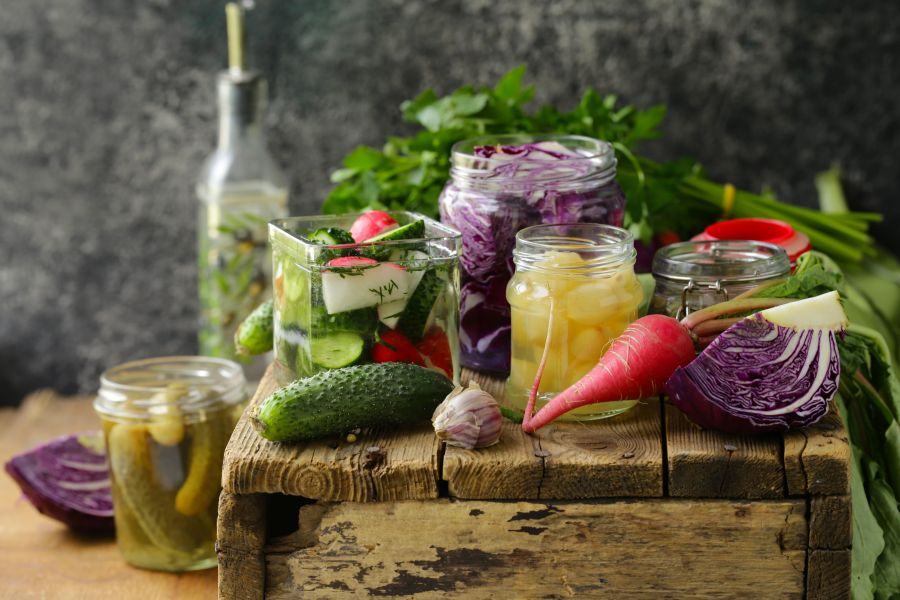
Sauerkraut and kimchi are more than just flavorful toppings. They’re fermented foods made with beneficial bacteria, which can produce compounds that may help keep your gut happy and healthy.
One study found that eating about 3.5 ounces of fermented vegetables daily for six weeks improved the gut microbiome.6
Try it: Add sauerkraut to sandwiches or grain bowls, or serve kimchi with rice, eggs, or vegetables.
Berries
Blueberries, raspberries, strawberries, and blackberries offer fiber along with plant compounds called polyphenols.
These compounds interact with gut bacteria and may help encourage the growth of beneficial bacteria, including Bifidobacterium, Lactobacillus, and Akkermansia.7
Try it: Add fresh or frozen berries to yogurt, oatmeal, berry smoothies, or salads.
Kiwi
Kiwi may be especially helpful if constipation is a problem. Its fiber can hold more water than the fiber in many other fruits, which can help soften stool and make bowel movements easier to pass.8
Kiwi is also rich in vitamin C, an important nutrient for immune health.
Try it: Slice kiwi over yogurt or oatmeal, add it to a fruit salad, or eat it on its own. You can also try this refreshing kiwi mint water recipe.
Habits That May Work Against Gut Health
A few common eating habits can work against gut health, too:9
- Not eating a variety of fiber-rich foods: Different types of fiber feed different gut bacteria, so variety can help support a more diverse gut microbiome.
- Eating too much sugar and saturated fat: Diets high in these foods may negatively affect the gut microbiome.
- Eating lots of ultra-processed foods: Some additives commonly found in processed foods may also affect the gut barrier and gut bacteria.
The good news? You don’t need a perfect diet to support your gut health. Adding a few of these foods to your meals throughout the week is a simple way to nourish your gut and the beneficial bacteria that live there.
References
[1] Mehta I, Juneja K, Nimmakayala T, et al. Gut Microbiota and Mental Health: A Comprehensive Review of Gut-Brain Interactions in Mood Disorders. Cureus. 2025;17(3):e81447. Published 2025 Mar 30. doi:10.7759/cureus.81447
[2] Le Roy CI, Kurilshikov A, Leeming ER, et al. Yoghurt consumption is associated with changes in the composition of the human gut microbiome and metabolome. BMC Microbiol. 2022;22(1):39. Published 2022 Feb 3. doi:10.1186/s12866-021-02364-2
[3] Fijan S, Povalej Bržan P, Šikić Pogačar M, Klanjšek P. Kefir Consumption and Health Effects Based on Human Clinical Trials: An Overview of Literature. Healthcare (Basel). 2026;14(5):652. Published 2026 Mar 4. doi:10.3390/healthcare14050652
[4] Fabiano GA, Shinn LM, Antunes AEC. Relationship between Oat Consumption, Gut Microbiota Modulation, and Short-Chain Fatty Acid Synthesis: An Integrative Review. Nutrients. 2023;15(16):3534. Published 2023 Aug 11. doi:10.3390/nu15163534
[5] Kadyan S, Sharma A, Arjmandi BH, Singh P, Nagpal R. Prebiotic Potential of Dietary Beans and Pulses and Their Resistant Starch for Aging-Associated Gut and Metabolic Health. Nutrients. 2022;14(9):1726. Published 2022 Apr 21. doi:10.3390/nu14091726
[6] Galena AE, Chai J, Zhang J, et al. The effects of fermented vegetable consumption on the composition of the intestinal microbiota and levels of inflammatory markers in women: A pilot and feasibility study. PLoS ONE. 2022;17(10):e0275275. doi:10.1371/journal.pone.0275275
[7] Lavefve L , Howard LR , Carbonero F . Berry polyphenols metabolism and impact on human gut microbiota and health. Food Funct. 2020;11(1):45-65. doi:10.1039/c9fo01634a
[8] Richardson DP, Ansell J, Drummond LN. The nutritional and health attributes of kiwifruit: A review. Eur J Nutr. 2018;57(8):2659-2676. doi:10.1007/s00394-018-1627-z
[9] Zhang P. Influence of Foods and Nutrition on the Gut Microbiome and Implications for Intestinal Health. Int J Mol Sci. 2022;23(17):9588. Published 2022 Aug 24. doi:10.3390/ijms23179588